The Welsh Government’s new Programme for Government 2026-2030 sets out an ambitious vision for “a stronger, more resilient rural Wales.”
Behind this commitment sits a recognition that rural Wales is navigating a period of profound change. Climate change is increasing pressure on farming and food production. Global events continue to expose vulnerabilities in supply chains. Rural businesses face economic uncertainty, while communities are adapting to demographic change, housing pressures and rising living costs.
The Programme for Government responds to these challenges by placing resilience at the centre of rural policy. The commitments outlined by the Welsh Government point towards a future in which rural communities are supported to adapt and thrive through sustainable farming, stronger local economies and environmental stewardship. Crucially, resilience should not simply be understood as the ability to withstand shocks. It is equally about creating the conditions for farms, rural businesses and communities to innovate, diversify and prosper, recognising that these challenges and opportunities are deeply interconnected.
This reflects a theme that has consistently emerged through Miller Research’s work in recent years.
Resilience Starts with Food
Perhaps nowhere is the challenge more visible than within our food system.
Food sits at the intersection of many of the priorities highlighted in the Programme for Government. It is fundamental to rural economic activity, public health, environmental sustainability and community wellbeing. Yet it is also increasingly exposed to shocks, whether from extreme weather, rising input costs, labour shortages or disruption to global supply chains.
Our work across Wales has repeatedly highlighted how action at local and regional levels can contribute to a stronger national food system. Research to understand the community food landscape identified growing recognition of the importance of local food production, stronger community food networks and greater collaboration across government, communities and industry to build long-term resilience. Similarly, our work examining local and regional food systems in North Wales highlighted the opportunities that exist to shorten supply chains, support Welsh producers, expand horticultural production and use public sector procurement more effectively to strengthen local economies.
These are precisely the types of interventions that can help translate the Programme for Government’s ambitions into practical change.
Supporting Rural Wales Through Transition
Delivering that change will depend heavily on how farmers and land managers are supported through the transition ahead.
The development of the Sustainable Farming Scheme reflects an ongoing effort to balance productive agriculture with environmental sustainability, climate adaptation and wider public value. Our work supporting both the consultation analysis and evidence review of the Scheme has highlighted the importance of ensuring that the transition is one that works for farmers, rural businesses and communities alike.
The challenge is not choosing between food production and environmental outcomes. It is creating systems that deliver both. Long-term resilience depends upon economically viable farm businesses, healthy soils, sustainable water management, thriving ecosystems and strong supply chains.
Thinking Beyond the Farm Gate
However, neither the opportunities nor the vulnerabilities end at the farm gate.
Recent Miller Research projects have explored how food security intersects with public procurement, health services, community development and civil resilience. Research examining NHS food security, for example, highlighted how climate change and supply chain disruption can affect essential public services, reinforcing the need for resilient and adaptable food systems.
Likewise, work on food resilience in Dyfed Powys reinforced the importance of local production, processing infrastructure, community capacity and long-term planning in preparing for future shocks and stresses.
Taken together, these projects suggest that resilience emerges when food production, public procurement, environmental management, health, infrastructure and community development are considered as part of the same system, rather than as separate policy challenges.
Turning Ambition into Delivery
The task now is to convert this policy ambition into coordinated and sustained delivery.
Many of the foundations are in place: a strong farming sector, growing local food networks, active community organisations and innovative businesses. The opportunity now is to connect these assets more effectively, creating the conditions for rural businesses and communities to adapt, diversify and build lasting prosperity.
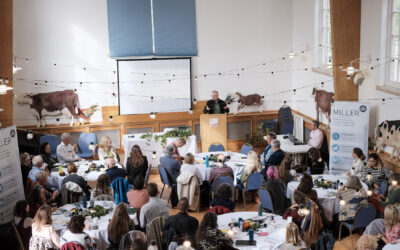
The discussion at Miller Research’s recent conference “A Resilient Food Future: Can Wales Rise to the Challenge?” reflected this growing consensus. Across policymakers, growers, researchers and practitioners, there was a shared recognition that building resilience will require collaboration, investment and long-term thinking.
The Programme for Government offers a framework for connecting these strands into a coherent vision for rural Wales. Success will ultimately depend on turning that vision into joined-up action across government, industry, public services and communities.
If it succeeds, the outcome will be more than a resilient farming sector. It will be a stronger food system, more prosperous rural communities and a rural economy equipped not only to withstand future uncertainty, but to innovate and prosper within it.