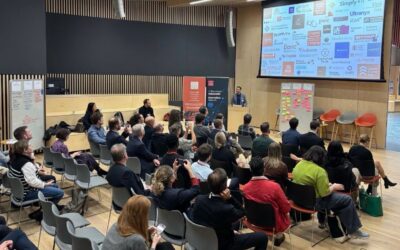
Last week I was delighted to be asked to speak at the Wales Centre for Public Policy conference on Decarbonisation and the Welsh economy on the theme of whether a more circular approach could support a post-growth economy. Standing in at short notice, I pulled together some broad thoughts about how circularity can shape thinking about a shift away from GDP as our primary metric of success and focus on creating greater value from fewer resources. This chimes well with the values that we espouse at Miller Research – our B Corp status demonstrates our commitment to people and planet over pursuit of shareholder profit, and much of our work is concerned with achieving public value through supporting greater efficiency in public services.
The text of the speech is summarised below, or you can read more about our work on circular economy here.
“To grow or not to grow – (that is the question!). WPCC has very ably set out the challenges of shifting away from GDP-driven linear growth. We decarbonise production, but produce more and consume more. More resources. More waste. In pursuit of more GDP. Kate Raworth lays out some of the reasons why GDP is something we might not want to do:
- GDP fails to take account of non-monetised goods and services;
- the caring economy – Unpaid carers provide no contribution to national wealth, apparently. Anyone who knows an unpaid carer or has a mother will be clear that this is nonsense.
- ecosystems and natural assets – fresh air has no value in the GDP world. And in simple terms, why protect something with no value?
- public goods – in the sense of the added value provided by paid labour in critical situations – a heart operation for example
- GDP also ignores assets. (Or debts). We can sell off the family silver if it adds to our bottom line. That’s fine until our external supplies of goods and services become scarce – for example the impact of the invasion of Ukraine on energy prices. So it exposes us in terms of resilience.
- Critically, as a measure, GDP is a blunt instrument, operating at national level, or averaged across the entire working population. It ignores inequality.
One measure of equality is the Gini coefficient, which measures inequality vs GDP per capita. The coefficient returns a value between 0 and 1, where 0 is perfect equality and 1 is where one person has all the wealth. The UK Gini coefficient for income is around 0.344[1], which is high in a European context and it has also become much more unequal over the last 40 years[2] (0.275 in 1982). Unsurprisingly England is more unequal than Wales (0.3), partially because it has a higher proportion of extremely wealthy people. In terms of wealth, ONS calculated that in 2016 the richest 10% of households in the UK held 44% of the wealth[3]. One other thing – GDP is not directly linked to personal well-being. So whilst, for example, in the mid-1990s wellbeing tracked GDP growth in Norway (albeit at a lower level), in neighbouring Sweden, wellbeing fell as GDP grew.
This disparity between GDP and wellbeing has led to innovations such as the famous Gross National Happiness Index in Bhutan. In 1972, the 4th King of Bhutan declared that “Gross National Happiness is more important than Gross Domestic product” and he commissioned a framework with nine dimensions of happiness that few would disagree with. I’ll just read these out. Maybe reflect on the UK today and consider where pursuit of GDP has led us and how well we are performing in these areas:.
- Psychological wellbeing
- Health
- Education
- Time use
- Cultural diversity and resilience
- Good governance
- Community vitality
- Ecological diversity and resilience
- Living standards
I rest my case.
So, I think it is fair to say that GDP has severe flaws and that Wales experiences significant inequality. To go back to the discussion, the post-growth perspective acknowledges that limiting GDP growth can adversely affect the poorest in society, potentially exacerbating that inequality. Hence there is a tension between saving the planet and supporting our most vulnerable citizens. So what are the options?
- GDP Growth is dead (see above)
- Green growth can offer a potential shift, but ultimately relies on resource use and does nothing to address the growth of consumption. I would compare it to the role of offsets on the path to Net Zero.
- If we focus on inputs, rather than outputs, it should be possible to grow value through the more efficient use of resources. To grow value by retaining that value here in Wales. This is where the circular economy comes in.
The Circular Economy – What is it?
Ellen MacArthur describes the circular economy as a shift from the linear process of extracting materials, making products and throwing them away, to a circular approach, where we stop waste being produced in the first place. It is based on three principles:
- Eliminating waste and pollution
- Circulating products and materials at their highest value
- Regenerating nature.
Let’s start with waste. On the face of it, Wales has a pretty good record here. We are World leaders in recycling (No 3). We have gone from 5% of domestic waste being recycled in 1999 to 65% by 2021. As a nation, we love recycling. Now we need to learn the next stage. Move up the ladder from recycling to repair and reuse – this is the second point. When you are done with something, sell it to someone else who can reuse it as it is. If it is broken, try and repair it (maybe using one of the excellent Repair Cafes across the network in Wales). As an example, Levi’s say that longevity and circularity is at the core of their business thinking, In the UK they have tailors who mend and alter jeans and they offer discounts in return for customers trading in denims of any brand and colour – which they then repurpose.
If it can’t be fixed, try and repurpose the bits for spares or remanufacture, then finally, if all else fails, use it for raw materials. We have a project with Greenstream Flooring – based in Porth in the Rhondda. A social enterprise, Greenstream reused or recycled 60,000m2 of carpet tiles last year, most of which would previously have gone to landfill. They provide affordable flooring to households which need it (including refugees), train volunteers and deliver substantial carbon savings. We are trying to monetise these as social impact offsets, to fund more good work, through our side project Exhibit-C.
So a circular economy approach replaces linear, extractive methods with regenerative practice: Cradle to cradle instead of cradle to grave, as resources are looped back as a feedstock for further sale, repair or repurposing. This reduces waste and maximises economic and environmental value. This is not about consumers and businesses having a collective damascene conversion to becoming eco warriors, it is about a paradigm shift in our economic model.
So what are the implications for industry? A circular approach needs a totally different approach to design, manufacture, distribution and retail – the whole supply chain. If producers understand that they will get their products back one day for repair or repurposing, they start to think differently. The responsible fashion trade has been strong here, with Finisterre, Patagonia and our own Hiut Denim offering repair services and resale shops. Typically, there is a shift from product to service. We are currently working with Riversimple – hydrogen car makers in Powys. They are pursuing a subscription model where users pay a single monthly fee plus a mileage rate to use the car. The payment covers all running costs including fuel. The implication for Riversimple is that they have the incentive to make the car as fuel efficient as possible to save fuel costs for themselves. Not only that, but they buy parts for their quality and longevity, as they want to minimise the lifetime cost, not the profit on sales. Going further, they are exploring servitisation of their supply chain – that is leasing the components for the cars from manufacturers, so the supply chain has an interest in overall quality and lifetime cost too.
Another example: Office Chairs. I always hated office chairs. We used to buy ours from a well-known online office supplies company. They came loose, fell apart, wobbled, failed. There was nothing to do with them except throw them out. Then back in 2008 I was lucky enough to hear Michael Braungart at the first Do Lectures in Cardigan. He was talking about cradle to cradle, and this was probably my first experience of the idea of technical and biological nutrients being endlessly recycled though the system. I was fascinated. Shortly afterwards I saw that Welsh manufacturers Orangebox had produced the first cradle to cradle accredited office chair – perfectly recyclable, and repairable. They were expensive but we got a deal on some second-hand ones – and we still have them all.
When businesses know they may get their products back, they make better products that last longer, ultimately using fewer resources, lowering costs and retaining value. Critically, they also build a relationship with their customers and are able to build brand loyalty and community.
Different models of ownership also have an impact on consumers. We love owning stuff. We need to go beyond recycling and stop buying so much stuff: We need to reduce. When we take the ownership element away from key goods, the relationship with the user changes. If you get away from the sunk cost of your personal car and shift to a Zip car model, where you can access a car when you need it, and then forget it, behaviour changes. Once every journey is visibly pay per trip, driving becomes more comparable with public transport. Car use reduces, active travel increases. The climate benefits. Community benefits. If we had a library of things on every corner, we wouldn’t need to own a power drill or a wallpaper stripper, we could reduce the demand for stuff.
Making it Happen
If we are serious about tackling climate change through economic policy, it will take bold leadership to make things work in favour of circular activity. A circular economy offers great opportunities for employment as it is more labour intensive than a throwaway society. It offers huge scope for innovation in products and services from reclaiming raw materials to developing efficient blockchain traceability systems for supply chain management. It can support a post-growth economy, through maximising value, lowering costs and building resilience. Embedding circular thinking can also be applied to other areas of the economy and society. If we are investing in preventative maintenance to maximise asset life, we could even apply the same thinking to health care and invest seriously in preventative medicine in community.
Hence we need to make a circular approach the default position.
What gets in the way and what can Governments do?
- Procurement – if we can get to grips with purchasing on the basis of lifetime cost, or carbon cost, we can transform the impact of public purchasing. MEAT – Most Economically Advantageous Tender has to go.
- Company legislation. Miller Research is a B Corp, so we have legally changed our articles to allow us to benefit people and planet, not shareholders. Although gradually changing under investor pressure, shareholder profit has consistently stood in the way of progress in decarbonisation.
- Taxation. What if businesses were taxed on use of raw materials rather than profit? Fresh inputs would be minimised and circular behaviour incentivised. Our colleagues at Copper8 in Amsterdam worked this through for the construction sector and the results were broadly revenue neutral for reasonable performers, whilst saving significant material resource.
- Investment in innovation and novel product design – Welsh Government has invested £1bn in recycling infrastructure already – but that investment offers rewards.
- Green Tape research, to identify regulatory barriers to change.
- Consider new approaches to finance – including public private partnerships – with public sector underwriting the risk and private sector bringing know how and technology. Then extend the model to include community.
- Social support – such as universal basic income, to ensure that the poorest on society are not adversely affected by changes
Above all, it requires collective effort, to recognise the benefits of behaving differently and embracing change. If we can achieve that, a circular approach can support green growth in the short term and post-growth for the long haul.
Thank you.”
[1] https://www.ons.gov.uk/peoplepopulationandcommunity/personalandhouseholdfinances/incomeandwealth/bulletins/householdincomeinequalityfinancial/financialyearending2021
[2] https://www.statista.com/statistics/872472/gini-index-of-the-united-kingdom/
[3] https://equalitytrust.org.uk/scale-economic-inequality-uk