In this year’s Green Man Festival (August 2026), our planned session, ‘the Museum of the Carbon Age’ didn’t go at all to plan. And it was much, much better for it.
Our premise was simple enough. In a large tent, we curated an exhibition where each exhibit is an item, practice, or concept from everyday life in the Carbon Age. These are the things that we hope will seem ridiculous in the future, in the same way we look at lead in our petrol and unlimited free plastic bags and think ‘yikes’! The exhibits had everything from ‘winter strawberries’ and ‘disposable coffee cups’ to ‘the weekend flight’ and ‘unlimited personal carbon consumption.’ Some were intentionally more controversial than others, with exhibits such as ‘pet ownership’ and ‘the privately owned car’ intended to spark debate.
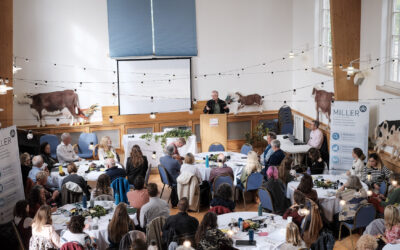
We planned to facilitate a workshop where we would discuss these exhibits with festival-goers. But those who came through the door (well, tent flaps) had something different in mind. We ended up with something far more fun, far more participatory, and far more telling about festival-goers’ views on the environment.
First, the stats. Every one of the 200 people who came into the tent were given three stickers. They were asked to vote using these stickers for the three exhibits that they most wanted to see in the bin of history. If they thought of something else, they were invited to write their own exhibits. And they certainly did! We had more ‘write-ins’ than original exhibits by the end.
And here are the numbers.
The most ‘dotted’ exhibit? The ‘artificial lawn’. The next most? ‘Using AI for everyday use’ (this was a write-in!). Next was ‘perpetual economic growth,’ followed by ‘multi-layered packaging’.
Here’s the raw data for those who like that kind of thing:
| Exhibit item | Number of stickers |
| The artificial lawn | 59 |
| Using AI for every-day use | 38 |
| Perpetual economic growth | 37 |
| Multi-layered packaging | 32 |
| The weekend flight | 31 |
| AI datacentres | 31 |
| The disposable coffee cup | 25 |
| The privately owned car | 23 |
| The lawn | 22 |
| The SUV | 22 |
| Animal-grown meat | 22 |
| Perpetual newness | 21 |
| Winter strawberries | 20 |
| Unlimited personal carbon consumption | 17 |
| Imported fresh-cut flowers | 16 |
| Disposable vapes | 15 |
| Patio heaters | 14 |
| Prisons | 13 |
| Obscene concentration of wealth | 13 |
| The tumble dryer | 11 |
| Ultra-processed food | 11 |
| Pet ownership | 10 |
| Private jets | 10 |
| Having children in the Carbon Age | 7 |
| Glow sticks | 6 |
| Slow walkers | 5 |
| Cruise ships | 5 |
| Social media | 5 |
| The personal wardrobe | 4 |
| Endless wars | 4 |
| Car dependency | 4 |
| Dinosaur bones | 4 |
| Plastic flowers | 3 |
| Low cost airlines | 3 |
| Log burners | 3 |
| Leaf blowers | 2 |
| Personal air conditioning units | 2 |
| Private swimming pools | 1 |
| Disposable plastic hand warmers | 1 |
| Hot tubs | 1 |
| Gigs and festivals | 1 |
| Privatised transport system | 1 |
| Mass product placement in everyday media | 1 |
| Normalisation of daily beef consumption | 1 |
(Italic text rows are the write-ins, non-italic text are original exhibits)
It should be noted that this wouldn’t pass muster for a rigorous survey of views, as the write-ins were only available to those who came after. But the stats are nonetheless interesting. AI drew a lot of attention – and none of our original exhibits included any mention of AI. This was entirely crowd-sourced. What we also found interesting was that social issues began to crop up as ‘write-ins’. ‘Prisons’ was an early one. The young lad who wrote up the card went away to think about it, then returned to write it up. It gained 13 votes by the end of our session.
I had wondered which exhibit would gather the most votes. That it was plastic lawns wasn’t hugely surprising. There is something egregious about an artificial patch of grass made entirely of plastic. But I was pleased to see some of the more ‘conceptual’ things voted for in good numbers. ‘Perpetual economic growth’ was given serious consideration, as were ‘the privately owned car’ and ‘perpetual newness’.
Tent conversations
Best of all, the conversations inside were fascinating. Encouraging people to choose only three options amidst (by the end) nearly four dozen exhibits really seemed to present a challenge. “I could have voted for all of them” was a phrase we heard again and again.
What’s interesting is that what was set out in the exhibit was a mixture of the very tangible and the most abstract. The ‘artificial lawn’ exhibit sat next to ‘perpetual economic growth’. Consigning something as obviously ridiculous as plastic grass to the scrap-heap of history is much easier to imagine than a world in which people make phones last a decade, repairing what’s damaged, upgrading where necessary. Some were conscious of this distinction. A couple that had wandered in chatted with us about how one of them had been drawn to the more concrete, tangible, while the other was drawn to vote for the more underlying, conceptual exhibits. Still, seeing ‘perpetual economic growth’ in the number three spot is heartening.
Those leaving the tent described different reactions to the exhibit. Some expressed hopelessness, sadness at the state of the world. Others found that the experience gave them a sense of hopefulness, especially later on as the number of votes grew, a visual indicator of shared frustrations.
Should we even be having kids?
Some of the exhibits were intentionally controversial.
‘Having children in the Carbon Age’ was one of the exhibits. This was intentionally controversial, and received 7 voted – a not insignificant number. Unsurprisingly, it invited some fascinating conversations.
‘I’ve already done the things that contributes the most carbon, probably,’ said one woman, pointing to her children who were browsing the exhibits. Others reflected on the kind of nihilism this view might present, a sense that to reject having children is to give up. One conversation stuck with me, where a middle-aged man spoke quite passionately about how the very people concerned about the impact of children on the environment were also best placed to raise the future leaders and ethical citizens needed to fight for the environment.
My personal favourite controversial exhibit was ‘pet ownership’ (inspired by having cat ownership forced upon me recently, and observing how the creature – at barely 3kg – eats more meat than I do). Some of our voters with pets felt similarly conflicted. Cats in particular, and their impact on local small animal/rodent biodiversity, was the main subject of discussion here, with one voter describing them as highly honed killing machines. They’re not wrong. ‘Pet ownership’ earned 10 votes. More than I might have expected.
Balance
This brings us to one of the most hot topic issues of all the chats in the tent: the balance between living life – and living well – with environmental considerations. ‘Weekend flights’ was lamented by those who had recently partaken, but who also recognised their impact with a sticky dot. Some spoke to us about their guilt at flying, especially short-haul ‘city break’ flights.
‘Well, we can’t never leave our houses and let life pass us by,’ I started saying back to them, as though they needed cheering up. ‘Really, we could put festivals like this on the list’ one of our punters said, looking around him.
And perhaps that was the most useful thing to come out of the Museum of the Carbon Age. Nobody left the tent with a neat answer to the question of how we should live. We like holidays, pets, strawberries, gigs and festivals. We also know that the way we consume, travel, entertain ourselves and organise our economy cannot continue indefinitely. Those contradictions are difficult, but they are also worth talking about.
We don’t know what will eventually end up in the real bin of history. Artificial lawns seem to have a pretty good chance. But for a few hours in a tent at Greenman, 200 people got to argue about what should go in there. And the conversations were much more interesting than we had ever imagined they could be!