Introduction
In the pursuit of Net-Zero and meeting Wales’ ambitious climate targets, understanding the environmental impact of our consumption patterns is crucial. Consumption-Based Emissions (CBEs) offer a pivotal perspective, attributing emissions from goods and services production to where they are consumed, rather than where they are produced. This blog delves into the significance of CBEs and emphasises why Local Authorities (LAs) in Wales should diligently measure them. Highlighting insights gained from analysing CBE data specific to Wales, we shed light on how this understanding can drive us towards a low-carbon, circular economy.
What are CBEs?
Standard territorial accounts of greenhouse gas emissions measure the direct emissions produced within a nation’s boundaries and offshore areas under its jurisdiction. By contrast, CBE accounts take a broader view by incorporating emissions embodied in imported goods and services consumed in Wales. While territorial emissions account for the climate impact of activities occurring within Wales, CBEs account for the climate impact of Welsh lifestyles. This includes emissions from various sources like food consumption (both inside and outside the home), heating, transport and the use of services.
The Welsh Government provides annual reports on CBEs for Wales as a whole. However, there is currently limited data availability at the local level for LAs to report on their CBEs, hindering effective development of climate policies, programmes and campaigns. The Local Authority Consumption Account (LACA) tool, developed by Dr. Anne Owen at the University of Leeds, addresses this challenge by providing time-series estimates of the Carbon Footprint for localities in the UK from 2001 onwards. These estimates offer quantitative measures of emissions associated with individuals or specific locations, encompassing emissions from the supply chains of goods and services consumed, regardless of the global location of those supply chains.
The importance of LAs measuring CBEs
Measuring CBEs at a local authority level presents several opportunities. Simply measuring the emissions associated with the buildings and transportation within the border of the LA overlooks the fact that the actions of local residents have impacts beyond their local area. When operating in a global economy, any measure of progress must consider impacts felt internationally as well as within communities.
This is particularly relevant for the UK nations due to a prevalence of high carbon consumer lifestyles and the practice of ‘offshoring’ emissions by importing goods and services from countries with lower production costs and less stringent environmental regulations. This means that while emissions are physically occurring elsewhere, the demand for these products is driven by UK consumers. If only production-based emissions are considered, the responsibility for these emissions is shifted to the producing countries, masking the true extent of the UK’s carbon footprint. Instead, CBE accounts capture the global reach of these impacts, and can support goals of the Well-being of Future Generations Act (2015) in the journey to a globally responsible Wales.
By measuring CBEs, LAs can provide a comprehensive account of activity, revealing the carbon footprint and cost-effective mitigation options associated with consumption-based accounts. These offer a robust evidence base for LAs to shape their efforts in collaboration with residents, businesses, and central government, to reduce those emissions in a fair and equitable manner. Implementing demand-side strategies, such as promoting the sharing economy and encouraging low-meat diets, also necessitates a consumption-based perspective to accurately determine their effectiveness.
Analysing Wales’ Consumption-Based Emissions
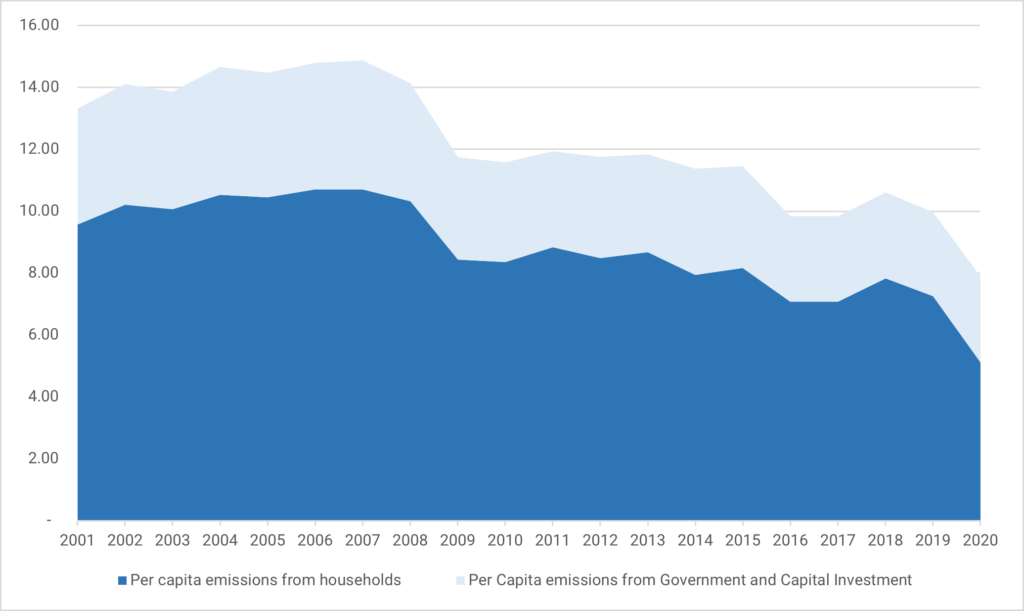
Analysis of CBE data specific to Wales (Figure 1) reveals a consistent decline in Wales’ consumption emissions footprint since 2001, in line with the overall UK trend. On the whole, CBE have decreased by 43% per capita since 2001, with household emissions seeing a 46% per capita decline during the same period. Notably, there was a notable decrease in emissions in 2008 during the financial crisis, and similar reductions were observed between 2018 and 2020 due to the pandemic response.
Figure 1: Wales’ Per Capita Consumption-Based Accounts (CO2eq)
Source: LACA data analysis
A closer examination of Wales’ CBE account highlights the primary sectors contributing to emissions in recent years. Housing, including embedded emissions within building materials, constituted the largest contribution at 39% of total CBEs in 2020. Transport followed at 26%, and food—consumed both inside and outside the home —accounted for 15%.
Figure 2: Wales Consumption Emissions by category (2020)

Source: LACA data analysis
Between 2001 to 2020, all LAs in Wales witnessed a decline in their CBEs. The emission profiles for LAs were quite similar (Figure 3), with only minor deviations between the highest and lowest emitting authorities. For instance, in 2020, Cardiff had the lowest CBEs per capita at 7.52t CO2, while Conwy had the highest at 8.2t CO2, indicating a difference of 0.68 tonnes.
The most noticeable variations across LAs were observed in the transport sector, primarily due to contextual factors. Notably, Cardiff exhibited the lowest CBEs in transport in Wales, attributed to higher public transport usage compared to other areas with stronger reliance on private transport or those situated in rural areas, such as Powys and Anglesey (1.25t CO2 per capita in Cardiff versus 1.43t and 1.46t respectively). In the housing sector, Blaenau Gwent had the highest emissions in 2020 at 2.31t CO2 per capita, while Ceredigion had the lowest at 1.83t CO2 per capita. In terms of food-related emissions, Cardiff and Ceredigion exhibited the lowest emissions in 2020, characterised by a lower proportion of meat consumption than other authorities.
Figure 3: Household Per Capita CBE data, by local authority, 2020 (CO2e)

Source: LACA data analysis
Understanding the data
While good progress is being made in Wales and its LAs toward achieving Net-Zero targets, there is also a need for more decisive action. The analysis underscores the necessity for significant structural changes in Wales, focusing on creating systems that enable low carbon, more circular lifestyles. This includes, for examples:
- Decarbonisation of housing and transport;
- Establishing redistribution infrastructure (e.g., for goods and building materials); or
- Expanding repair, reuse, rental and sharing services within our communities.
However, achieving these structural changes will need to go hand in hand with a behavioural change to the way Welsh consumers shop, eat and travel. The decarbonisation of housing and transport, for example, will rely on creating both the right enabling conditions and behavioural changes that embrace new, environmentally friendly ways of living – supported by awareness raising and guidance on the necessary changes individuals should make. The Welsh Government published their Public Engagement Strategy (2023–2026) in July, laying out a framework for supporting and engaging people and communities of Wales in action on the climate and nature emergencies. This strategy is a crucial initial step toward bringing about change.
If you want to explore CBE data for your local authority in more detail or discuss targeted approaches to support the transition to a low carbon, circular economy across different sectors, please get in touch!