Like so many other businesses across the UK, the Miller Research team has spent the majority of the last 9 months working from home.
During a conversation with a colleague recently, we got onto the subject of the impacts that working from home has had on our lives, especially the reduced commuting. We wondered: with everyone in Miller Research working from home, how much petrol and diesel had been saved? And as a result, how much less CO2 have we been emitting due to our cars sitting idle during working hours?
These were interesting questions, we thought, so we got to work calculating it.
The Calculations
To come up with an estimated figure for CO2 emission saved from less commuting, we noted the distance driven by each Miller Research team member for their daily commute.
Then, using data held on the model of car each team member drove, the daily and weekly CO2 emissions for each individual’s car was estimated. This was multiplied to cover the 23 weeks between the last week of March (when lockdown started) and the last week of August, taking into account that one team member joined us half-way through lockdown. Two weeks were then deducted from each team member to account for holiday time in which individuals would not have been driving into work. Some of us work part-time, and so their weekly commuted distances were adjusted accordingly.
Finally, after all the number crunching, we came to some interesting figures.
Around 25,700 combined miles would have been driven in total over the 23 weeks under consideration. To put that into perspective, the circumference of the Earth’s equator is 24,901 miles!
This is an astonishing distance for a team of 12!
Now for CO2 emissions. In these 23 weeks, our cars would have emitted around 4,648 kilograms of CO2. That’s 4.6 tonnes of CO2 emissions saved.
Four-and-a-half tonnes of CO2 is clearly a large number. But it needs some context to make sense of it.
How much CO2 is 4.6 tonnes?
First of all, let’s understand how it is that a gas like CO2 can have weight. If you’re as confused as I was about how “heavy” a gas is, and what 1kg of CO2 would look like, this blog provides a useful explanation. Gasses have a surprising amount of weight. A gallon of CO2, trapped in a container, would weigh around 7 grams.
Which means, quite terrifyingly, that the 4.6 tonnes of CO2 that we would have emitted during those 23 weeks would equate to 642,857 gallons of CO2, just shy of the volume of an Olympic swimming pool at 660,430 gallons.
Everyday CO2 Impact
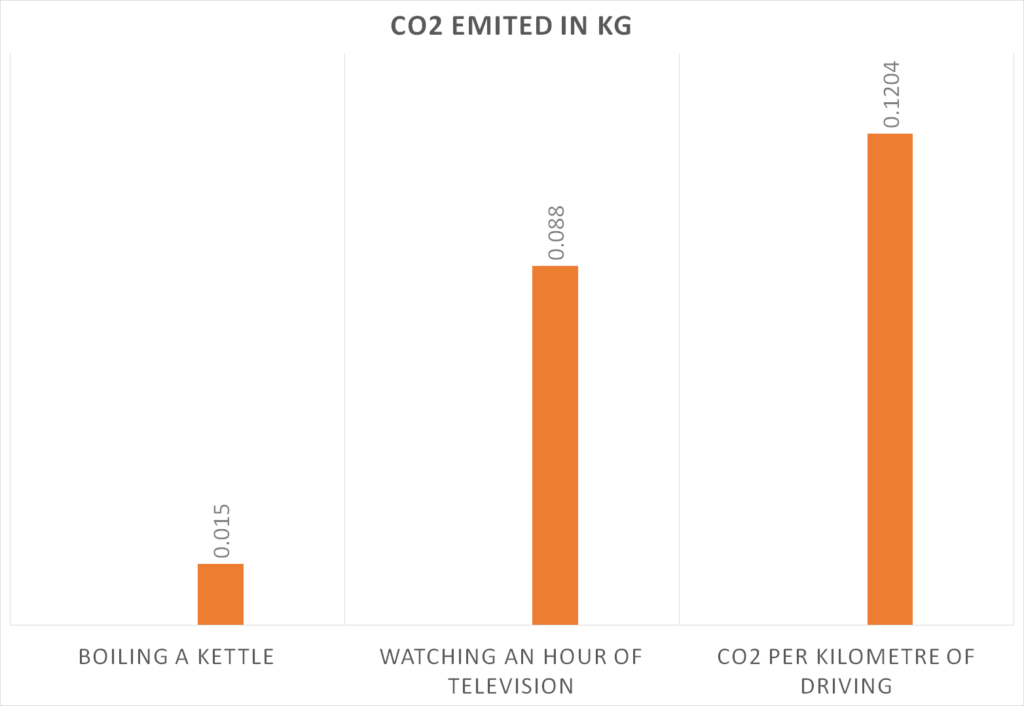
But how does the 4.6 tonnes of CO2 that would have been released compare with the impact of our other carbon-emitting activities? Here are some stats on ordinary activities and their CO2 implications.
Boiling an ordinary kettle will generate around 0.015kg of CO2, or 15 grams. Which means boiling the kettle five times a day (which is about average for me) releases 75 grams of CO2, around 10 gallons in volume.
The carbon footprint of watching a digital terrestrial television is 0.088kg CO2 per viewing hour, or 88 grams.
These add up.
In 2014, the average household produced 8.1 tonnes of CO2 annually, which breaks down to just over 22kg per day.
According to World Bank figures from 2014, the average annual CO2 emissions per person on the planet was 4.982 tonnes.
In 2016, it reported that the average CO2 emissions for each person in the UK was 5.8 tonnes. The European Commissions’ Joint Research Centre in 2019 calculated the UKs annual CO2 emissions per person as 5.587 tonnes, a slight reduction.
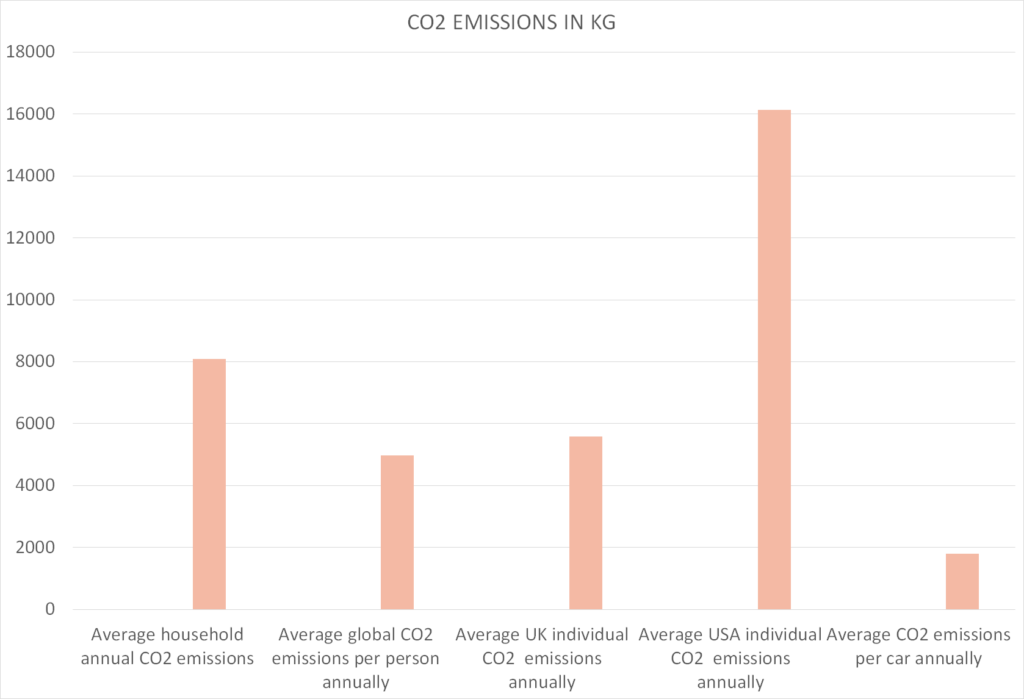
In contrast, the USA had a figure of 16.144 tonnes of CO2/per person!
Cars and emissions
Cars are clearly a significant source of our household emissions and of the 5.587 tonnes of CO2 we each produce annually.
Passenger cars produced in the EU in 2018 will on average produce 120.4 grams of CO2 per kilometre, an improvement on cars produced in 2008, which emitted 153.5 grams per kilometre. At these figures, 10,000 miles driven annually would result in 1,937kg, or 1.937 tonnes of CO2 per year. In fact, this figure is very close to the actual average CO2 emissions per car in the UK, which was recorded in 2015 as 1.8 tonnes of CO2 per year.
Importance of saved emissions
The need for a reduction in Green House Gas emission from transport is clear.
Transport is the most polluting sector in the UK, emitting more CO2 than either the power generation industry, construction or manufacturing. The ONS reports that one fifth of UK greenhouse gas emissions come from road transport – calculated as 119.6 million tonnes in 2019. Commuting has long contributed heavily to this pollution.
But lockdown has provided us with an opportunity to re-think how and where we work, and as a consequence, we can re-evaluate our relationship to commuting.
A significant benefit of lockdown was a sharp reduction in commuting and car usage due to much of the workforce working from home, as well as general restrictions on travel.
The UK Government’s own figures report that 46.6% of the UK workforce worked at least partly from home in April 2020, the height of the lockdown, with over 86% of this home-working coming as a consequence of COVID-19.
Roads were eerily quiet during what should have been peak rush-hour, and air quality improved across the cities and towns of the UK. During Lockdown, traffic at 275 monitored sites were between 35-45% of their usual levels.
The question now is how much of this benefit can be maintained as and when life starts going back to “normal;” how can we establish a new normal in which we commute – and pollute – less?
The future
Should working from home become increasingly normalised, a longer-term benefit may be a more permanent reduction in transport emissions.
This would certainly help in the Welsh Government’s efforts to move towards a low carbon Wales. Having declared a climate emergency in 2019, the Welsh Government set out its commitment to tackling climate change in its 2019 plan, Prosperity for All: A Low Carbon Wales, which sets out the goal to reduce transport sector emissions by 43%.
The impact of lockdown on working norms will certainly aid this pursuit. A shift to more working from home has been explicitly stated as an aim for the Welsh Government. Its long-term ambition is for 30% of the Welsh workforce to work remotely, with reduced pollution and congestion noted as part of the rationale.
Time will tell as to whether this ambition will be realised.
But there is hope that out of this dark time for the Wales and the world, we can seize the opportunity it provides to address some of our most polluting behaviours. After all, even a cloud of smog can have a silver lining.